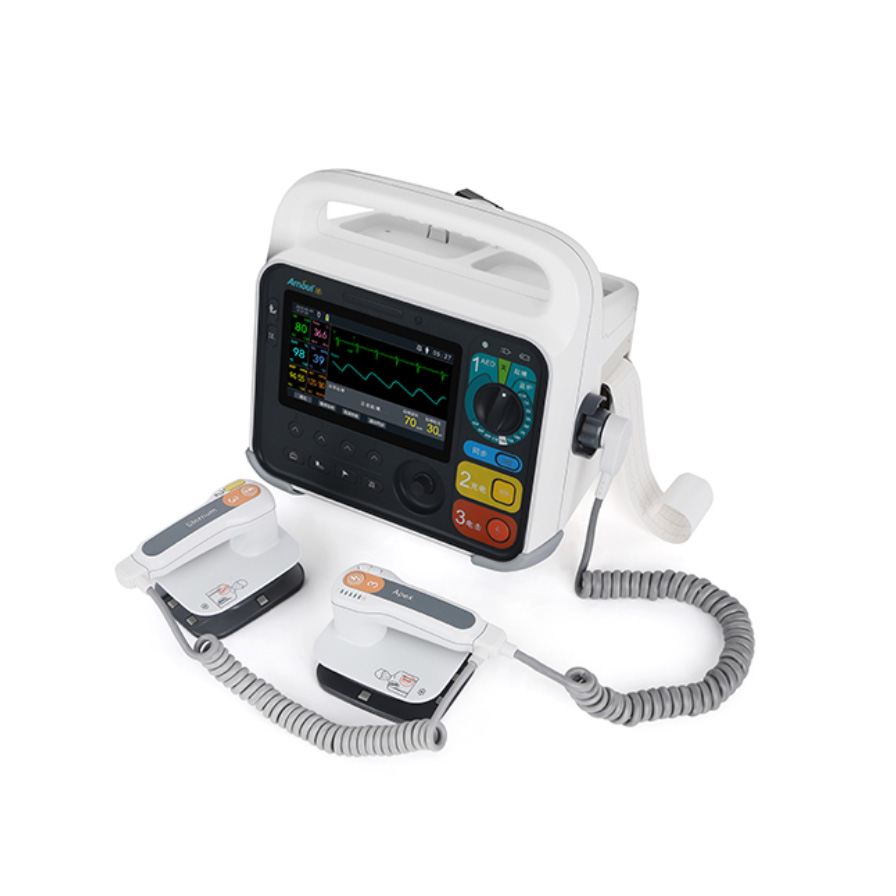
The design philosophy of the i6 Defibrillator & Monitor is to simplify the operating process so that non-professionals can take quick action in emergency situations. Manual defibrillation requires only three steps, namely turning on the device, attaching electrode pads and pressing the discharge button to complete a defibrillation operation. This user-friendly design greatly reduces the possibility of operational errors and ensures effective rescue within the golden rescue time.
The device's compact size and light weight make it easy to carry and deploy, making it quick to use whether inside a medical facility or at an outdoor emergency scene. Its wide range of applicability is not only suitable for adults, but also for children and newborns, making it ideal for a variety of situations.
In terms of energy output, the i6 Defibrillator & Monitor offers multiple grades from 1 Joule to 360 Joules, including 1~10J, 15J, 20J, 30J, 50J, 70J, 100J, 120J, 150J, 170J, 200J, 300J and 360J , such a wide range can meet the needs of different patients and situations.
In addition to its powerful defibrillation capabilities, the i6 Defibrillator & Monitor also has comprehensive monitoring and measurement capabilities. It can perform 3-lead and 5-lead electrocardiogram (ECG) monitoring, blood oxygen saturation (SpO2), non-invasive blood pressure (NIBP), respiratory rate, end-tidal carbon dioxide (EtCO2), body temperature and event recording. These comprehensive monitoring functions are Comprehensive patient evaluation and subsequent treatment provide important information.
Charging speed is one of the key measures of defibrillator efficiency. The i6 Defibrillator & Monitor also excels in this regard, charging in just 5 seconds at an energy level of 200 joules. This means that in an emergency, rescuers can be ready for the next defibrillation more quickly.
The design of the defibrillation handle integrates charging, discharging and energy selection functions, making operation more intuitive and faster. This user-friendly design ensures that rescuers can complete operations accurately in high-pressure environments.