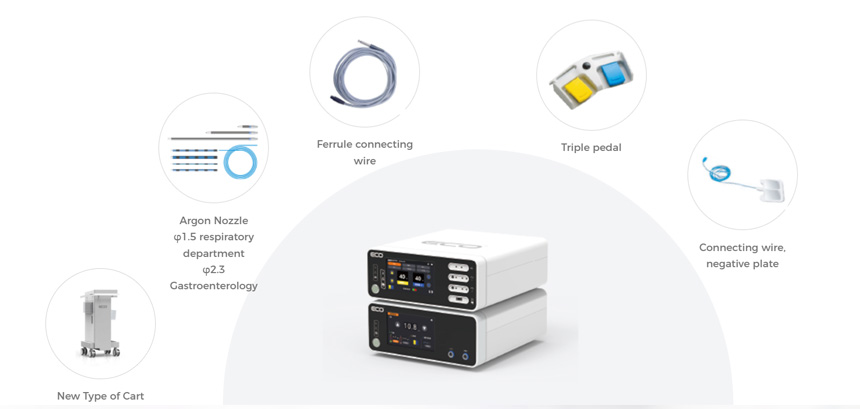
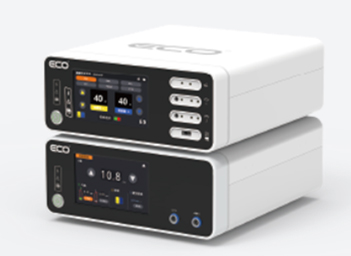
ECO Argon High-Frequency Electrosurgical Knife

- Point of origin
- China CE ISO13485 ISO9001
- Application scenarios
- Respiratory Medicine, General Surgery, Gynecology, Urology
Argon High-Frequency Electrosurgical Knife:
eco argon high-frequency electrosurgical knife operates on the principle of using special electrode consumables to access the patient's natural cavities through a soft lens. This approach allows for the precise cutting and coagulation of diseased tissue, minimizing damage to surrounding healthy tissue. By integrating with an argon module, the knife can perform coagulation under the protective blanket of argon gas, further enhancing its safety and efficacy.
The benefits of the argon high-frequency electrosurgical knife are manifold. Firstly, it enables surgeons to perform procedures with greater accuracy, as the device can be controlled with a high degree of finesse. This precision is particularly valuable in surgeries where millimeters can make a difference in outcomes, such as in neurosurgery or ophthalmology.
Secondly, the use of argon gas during the coagulation process helps to reduce bleeding by providing a protective barrier that minimizes oxygen exposure to the treated area. This not only decreases the risk of infection but also speeds up the healing process, as tissues are less prone to oxidation and inflammation.
Furthermore, the argon high-frequency electrosurgical knife has broad applicability across various medical disciplines. In gastroenterology, it can be used for procedures such as airway stenosis and polypectomy, where the precision offered by the device is critical to avoid damaging the delicate structures of the digestive tract. In respiratory medicine, it assists in maintaining clear airways by removing obstructions without causing excessive scarring.
In general surgery, the knife is invaluable for tumor resection, where clean margins are essential to prevent the recurrence of cancerous growths. Gynecologists and urologists also find the tool indispensable for open hemostasis procedures, where controlling bleeding is crucial to protect both the patient and the surgeon's field of view.
Application Departments | Gastroenterology, Respiratory Medicine, General Surgery, Gynecology, Urology, and other departments |
Application items | airway stenosis, polypectomy, gastrointestinal bleeding, tumor resection, and open hemostasis |
display | Blocking reagent and system |
operation | Can store more than 12 groups of programs , independently remember the function status and value settings of the last work , ready to use |
System | millisecond - level dual feedback automatic control |
Modular Design | independent CPU safety management and controi , convenlent for later software and hardware maintenance and upgrade |
Argon high-frequency electric knife is based on the traditional high-frequency electric knife instead of mechanical scalpel for tissue cutting. With special electrode consumables, it enters the patient's natural cavity through a soft mirror to cut and coagulate the lesion tissue. It can cooperate with Argon module, to carry out coagulation under the protection of argon.
Departments of Gastroenterology, Respiratory Medicine, General Surgery, Gynecology, Urology, and other departments, suitable for operations such as airway stenosis, polypectomy, gastrointestinal bleeding, tumor resection, and open hemostasis