In global health, especially in low- and middle-income countries (LMICs), access to diagnostic resources is often limited by infrastructure and economic conditions. A recent editorial letter published in the journal Clinical Microbiology and Infection brings hope to diagnostic practices in these countries. The study shows that blood culture bottles (BCBs) can maintain their effectiveness even after expiration when stored in simulated tropical conditions for several months.
In resource-limited settings, the use of medical equipment consumables is often limited by shelf life and storage conditions. However, this new study conducted by researchers from the Institute of Tropical Medicine (ITM) in Antwerp, Belgium, and FIND in Geneva, Switzerland, shows that some blood culture bottles can maintain their ability to culture blood samples after storage at controlled room temperature and extreme "tropical" conditions, even beyond the manufacturer's stated expiration date.
Blood culture bottles for fully automated blood culture systems are key tools for diagnosing sepsis, but their storage stability is a challenge in LMICs with high temperature and humidity. Currently, most manufacturers recommend that BCBs be stored in a temperature range of 20-25°C, but climatic conditions in LMICs often exceed this range. In addition, the Target Product Profile (TPP) proposes a 12-month shelf life requirement for BCBs used in LMICs, but this does not take into account the lengthy process of international transportation, customs clearance, and domestic distribution.
To verify the stability of BCBs, the research team selected five brands of aerobic children's BCBs, including Autobio, DL-Biotech, Schenker, Mindray, and bioMérieux. Some BCBs were stored at controlled room temperature and some in a climate chamber simulating tropical conditions (45°C, 90% humidity) for 4-7 months beyond their expiration date. Monthly, the researchers inoculated these BCBs with defibrinated horse blood containing different concentrations of Escherichia coli, Staphylococcus aureus, Pseudomonas aeruginosa, Streptococcus pneumoniae, and Candida albicans and incubated them in blood culture machines from the relevant manufacturers.
The results of the study showed that the shelf life of all BCBs tested exceeded the manufacturer's stated expiration date when stored at controlled room temperature. In addition, some brands maintained their performance even under extreme "tropical" temperature and humidity conditions, while others were severely affected. For example, bioMérieux's BCBs no longer supported the growth of C. albicans and P. aeruginosa after short storage at 45°C, while DL-Biotech's BCBs showed a progressive decrease in yield and an increase in median time to positive (TTP) for all species tested starting from month 12.
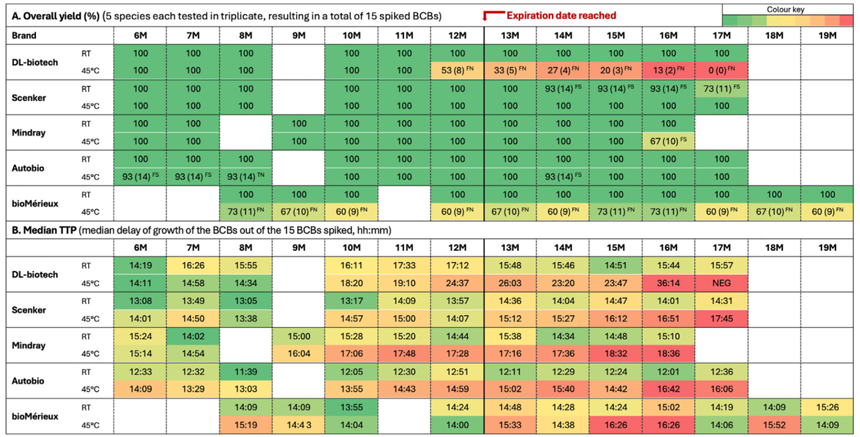
Overview of the performance of spiked BCBs stored at room temperature and at high temperature/humidity until and after the expiration date. Panel A shows the overall yield (percent true positives) at each evaluation moment. Panel B gives the median TTP (time to positive) for all true positives for the 15 spiked BCBs at each evaluation moment. RT = room temperature, M = months after production, blank cells = not performed. FN=false negative BCB (no signal but subculture growth), TN=true negative BCB (no signal and no subculture growth), FS=false signal BCB (signal within 4 hours after incubation)
The significance of this study is that it provides important insights for clinical bacteriology services in LMICs. In Africa, only 1.3% of biological laboratories currently provide bacteriology testing, and the continent suffers from the highest mortality rate of antibiotic resistance in the world. Study author Liselotte Hardy emphasized that in order to improve access to diagnostics, the shelf life of diagnostic products should be reconsidered. The research team called on manufacturers to review their storage temperature guidelines and report longer stability test results. This will not only help save costs and reduce waste, but will also promote access to diagnostic services in more remote areas and LMICs. In addition, policymakers should encourage manufacturers to report stability testing at longer times and higher temperatures. This study provides a new perspective on medical practice in LMICs, showing that medical supplies may still maintain their effectiveness even after exceeding the traditional shelf life. This is not only a positive signal for resource-limited areas, but also provides valuable experience for the global health field on how to use and allocate medical resources more effectively.
Auto Blood Culture Detection System PM-BT32 is high performance, cost-effective, and ideal equipment for biological laboratories. For more search: www.powfo.cn/ProDetail.aspx?ProID=285